
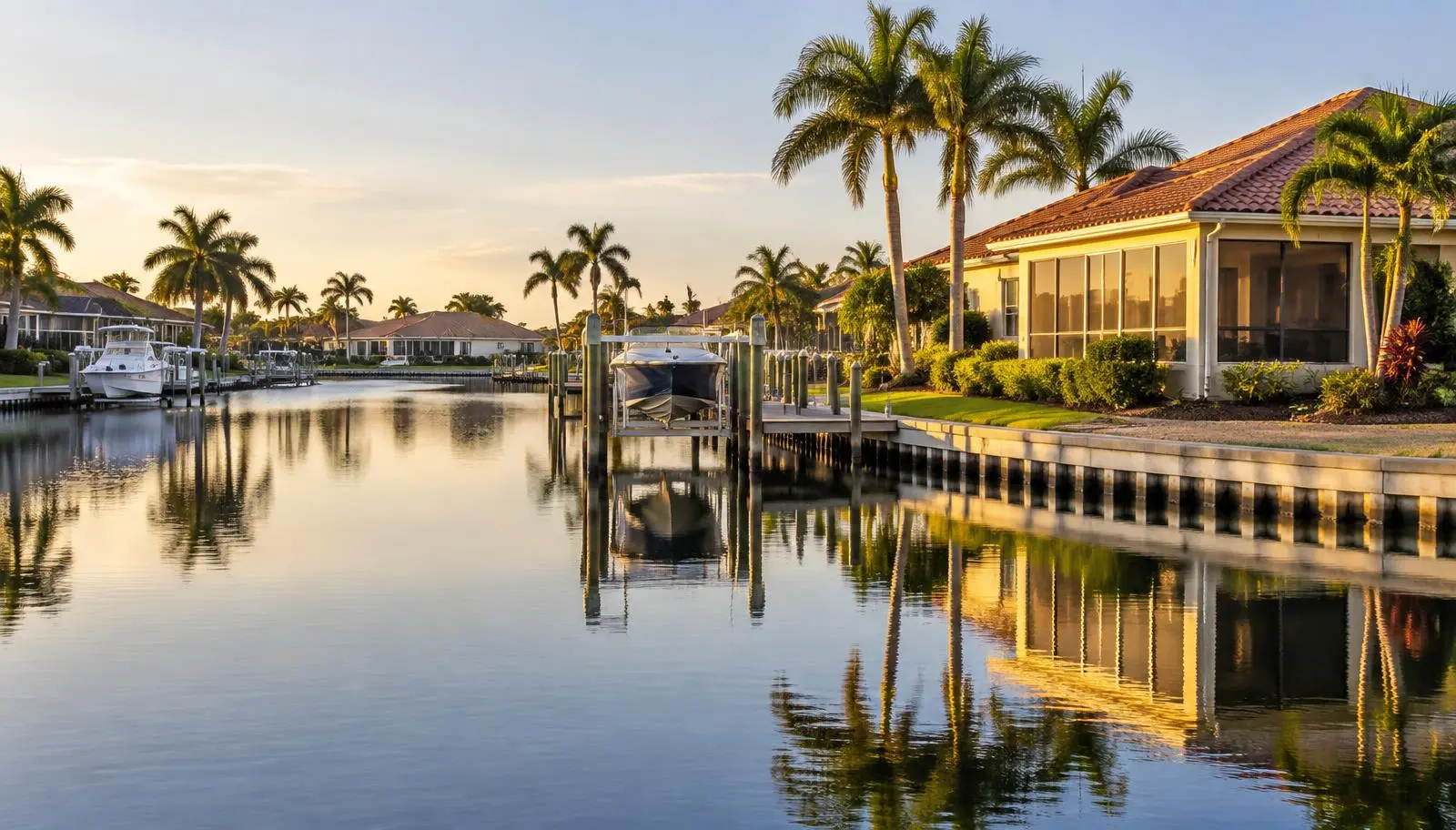
The community
Port Charlotte, Florida
Port Charlotte is a community in Charlotte County on Florida's Gulf Coast, set along the northern shore of Charlotte Harbor. Much of it was developed beginning in the 1950s as a planned residential community, and today it is made up largely of single-family neighborhoods, many of them laid out along a network of residential canals. The Port Charlotte entry on Wikipedia (opens in a new tab) offers a useful overview of its history and geography.
For homeowners, that combination of a subtropical climate, low-lying terrain and nearby water shapes how houses age. The roof edge, where rainwater leaves the house, is one of the places those conditions show up first.
Rain and runoff
Rainfall and roof drainage
Like much of Southwest Florida, Port Charlotte has a distinct rainy season, generally running from late spring into early fall. During those months, afternoon thunderstorms are common, and they can produce a lot of rain in a short time. Drier months bring lighter, less frequent rain.
For a house, the intensity matters as much as the total. A roof collects rain over its entire surface and sends it to the edges within minutes. Without gutters, that water drops in a line along the eaves. With gutters that are undersized, poorly pitched or short on outlets, it overflows in the same places anyway.
Managing that runoff comes down to a few basics: enough gutter capacity for each roof section, a steady slope toward each outlet, and downspouts that release water somewhere it can drain. When those basics are in place, heavy afternoon storms become routine rather than a recurring source of problems around the house.
Waterways
Canals, waterfront lots and drainage
Canals are one of Port Charlotte's defining features, and many homes back onto the water. Waterfront and inland lots alike tend to be fairly flat, which means runoff does not always move away from a house on its own. Water released at the base of a wall can linger near the slab or collect in low spots in the yard.
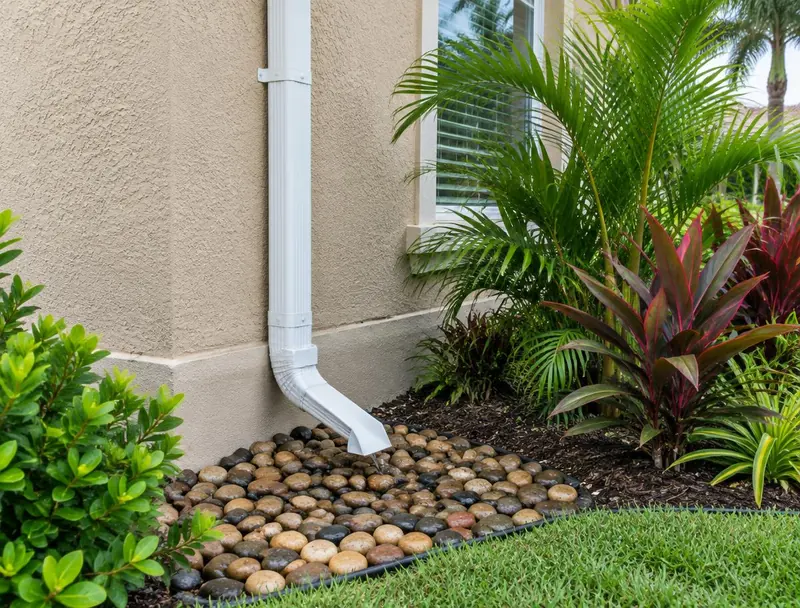
Every property is different, and drainage depends on grading, soil, landscaping and hardscape as much as location. What is consistent is the principle: roof water should be carried away from the structure and released where the ground can absorb it or a swale can carry it off. Downspout placement, extensions and splash areas all play a part.
If you would like to see how the community is laid out, this map of Port Charlotte (opens in a new tab) shows how closely many neighborhoods sit to the harbor and canal system.
Home exteriors
Florida home exteriors and the roof edge
Many Port Charlotte homes combine stucco walls with tile, shingle or metal roofs. Each roof type sheds water a little differently, and each affects how a gutter is positioned to catch it.
The parts that sit at the roof edge carry most of the exposure:
- Gutters
- Collect runoff along each roof edge and carry it to outlets. Sun and heat age sealants at joints over time.
- Fascia
- The board gutters fasten to. When it stays wet, it deteriorates and stops holding fasteners well.
- Soffit
- Closes the underside of the overhang. Vented panels help air move into the attic space.
- Downspouts
- Decide where roof water ends up. Their placement matters on flat lots with sandy soil.
Moisture
Humidity and moisture
High humidity is part of everyday life in Port Charlotte for much of the year. Surfaces that get wet dry slowly, which matters most for wood at the roof edge. A gutter that drips at a seam or overflows during storms can keep the fascia behind it damp far longer than it would be in a drier climate.
Over time, that is what leads to peeling paint, staining and softened wood. Keeping gutters working properly, and addressing roof-edge damage early, helps limit how much moisture those components absorb.
Practical steps
Protecting the property around the roofline
Watch during a storm
See where water overflows, drips or sheets off the roof. It shows where the system needs attention.
Check where downspouts discharge
Water should be released away from walls, entries and lanais, not at the base of the slab.
Look at the fascia
Staining, peeling paint or soft spots usually trace back to water escaping the gutter.
Keep debris in mind
Palms, oaks and pines drop material that can block outlets just when heavy rain arrives.
Serving Port Charlotte
Gutter services for Port Charlotte, FL and surrounding areas
Port Charlotte Gutters works with homeowners and businesses throughout Port Charlotte, FL and surrounding areas on gutter installation, replacement and repair, soffit and fascia, gutter guards and downspouts. To learn more about how we approach each project, visit our Port Charlotte gutter company home page, or call to arrange a free estimate.